Mountains and Memory (The Glacier's Memory)
The Eight Mountains: A NovelMountains and memory are inseparable in the novel’s account of Pietro’s changing understanding of Giovanni Guasti and of his own past. A glacier preserves what the passing summer appears to erase; a map and summit notebooks make that persistence legible, while returning to particular landscapes lets the living encounter histories they did not know in full. Memory here is not simply recollection. It is carried by routes, handwriting, weathered paper, and a house built in the place where Pietro and Bruno’s shared life took shape.
The Glacier as a Model of Memory
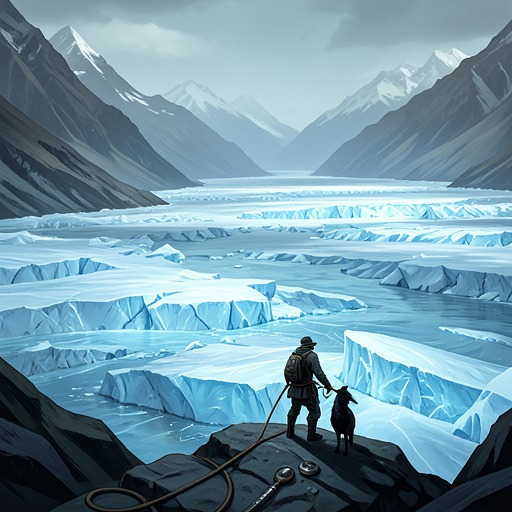
After hearing his mother’s account of the past, Pietro recalls how Giovanni spoke about glaciers. His father disliked retracing his steps or dwelling on unhappy times, yet something could return to him when he looked at a glacier, even on a mountain where no friend had died. He described the contrast between summer’s melting and the ice that remains: “the summer erases memories, just like it melts the snow; but the glacier is the snow of winters long past; it is a memory of winter that does not wish to be forgotten.” The image gives memory a physical form. What seems to have vanished from immediate view has not necessarily disappeared; it may persist, altered and held in reserve, until a place brings it back.
This understanding changes Pietro’s picture of Giovanni. He recognizes two versions of his father: the city-dwelling stranger from whom he had been estranged, and the mountain man he had only partly seen, who walked behind him on paths and loved glaciers. The distinction does not erase their painful separation. Instead, the mountain landscape lets Pietro recognize a fuller identity that the years of distance had concealed. Giovanni’s legacy becomes not a complete explanation of the past but a ruin at Barma that Pietro can rebuild as an act of remembrance.
The Father's Mountain Map
The map that Giovanni left thumbtacked to the kitchen wall first appears to Pietro as a changed and almost unreadable object. It is no longer merely a map of valley trails: over twenty years, his father’s felt-tip pen has reached summit after summit, alpine pasture after alpine pasture, and refuge after refuge. Routes in black, red, and green cross and overlap until the accumulated journeys resemble a biography. The map turns repeated movement through the mountains into a record of a life.
Pietro studies the colored lines as though solving one of his father’s childhood riddles. The three colors recall the occasion when Pietro, Giovanni, and Bruno were stuck together on the glacier. Red and green stop at the point where the black route continues, revealing to Pietro that Giovanni completed the remaining climb alone on another occasion. He infers that black represents his father, red represents himself, and green represents Bruno. The code makes the map intimate rather than merely topographical: it records who accompanied Giovanni, where shared excursions ended, and where he continued by himself. Pietro notices many routes traced in black and green, perhaps more than those in black and red. The discovery stirs jealousy, but also relief that his father had not spent all those years alone. The map may contain a message for him, though its meaning emerges through reading rather than through any explicit explanation from Giovanni.
Summit Notebooks and Encounters
Pietro finds another kind of record on a barren mountain above his house. In a metal box among the summit stones lies a notebook inside a plastic bag, its ruled paper marked by water. Fewer than ten people climb the mountain in a typical year, so its pages hold a long record of rare visitors. Pietro finds Giovanni’s 1997 entry: “Climbed up from Grana in 3 hours and 58 minutes. Still in great shape!” The brief boast gives a precise measure of one ascent and an unmistakable impression of his father’s good humor. Pietro imagines Giovanni hurrying to reach the summit in under four hours, but leaves the page in the notebook rather than tearing it out, treating the record as something that belongs to the mountain as well as to the family.
In the weeks afterward, Pietro follows the routes on the map to lesser peaks and neglected valleys rather than joining the crowds heading toward Monte Rosa around the August bank holiday. There he meets solitary climbers of his father’s generation. Their greetings, conversations, and shared food make each encounter feel like a possible meeting with Giovanni; the older men, in turn, sometimes seem to regard the young climber as a son. They return to the same mountains over decades, preferring valleys where little seems to change. One man describes an annual climb as a return through his own recollections. His account echoes Pietro’s discovery that a familiar route can hold a life’s history in its turns.
The summit books add distinct moments to the map’s broad network. Giovanni’s entries are often laconic and boastful: “Done this one too. Giovanni Guasti.” Elsewhere he notes ibexes, eagles, and fresh snow, or thick fog, old songs, and the view from the summit. Pietro knows the songs and wishes he could have sung them with his father in the fog. One more melancholy entry imagines staying on the mountain together and never returning to the valley. Pietro copies those words and their date into his own notebook, but does not write in the summit books. The difference matters: he preserves Giovanni’s voice without replacing it with his own.
Place, Inheritance, and Witness
The mountain records do not offer a complete account of Giovanni. Their brevity leaves questions open: who he meant by “all” in his wish to remain on the mountain, or what prompted the thought. Yet their incompleteness is part of their force. The map and notebooks reveal repeated actions and moods, while leaving Pietro to connect them with what he remembers and what his mother has told him. The mountain is an archive, but not a key that unlocks every secret.
At Barma, memory becomes a shared, public act. After Pietro and Bruno build the house, Pietro’s mother climbs up to see it. She looks out from the window and then carefully takes in the lake, scree, peaks of Grenon, and the house, as if committing the scene to memory. On the rock wall, Pietro has made an inscription in black paint bearing Giovanni’s name and dates, 1942–2004, and the words: “IN MEMORY IS THE MOST BEAUTIFUL REFUGE.” His mother stands looking at it; then she calls for a song traditionally sung when a lover of the mountains dies, asking that he be allowed to walk in the afterlife. The inscription fixes remembrance in the landscape, while the song gives it a communal voice.
Pietro then says that the house should belong not only to him but to him and Bruno, because they built it together. He believes this is what Giovanni wanted, but also says that he wants it himself. Memory thus leads beyond private recovery: the inherited ruin becomes a shared home, and the father’s absence is acknowledged through a future that the two friends make together.
The Unreturnable Mountain
Pietro’s later journey in the Himalayas clarifies that not every landscape can become a substitute for the one that holds a life’s history. In spring, he chooses a region he has never visited rather than retracing a remembered route. Curiosity returns in small acts: leaving the trail to reach a ridge, lingering in a village, and spending an afternoon beside river pools. These unplanned explorations recall the way he and Bruno moved through the mountains. Yet the unfamiliar country lacks the history he reads in Grana. Pietro reflects that a place can be the custodian of a person’s past, and that other mountains remain secondary by comparison, even when they lie in the Himalayas.
The journey does not resolve loss by bringing Pietro back to a finished understanding. He remembers learning from Giovanni that some lives contain a mountain to which return is impossible: the mountain at the center of the others and at the beginning of one’s story. For those who have lost a friend on that first, highest mountain, he thinks, wandering among the eight mountains is what remains. The image gives memory both its sustaining power and its limit. Landscapes can preserve a bond, make fragments of the past available, and guide the living toward new journeys; they cannot restore the lost person or make the central mountain fully returnable.